Decision Latency: The Cloud Cost That Never Appears on Your Bill
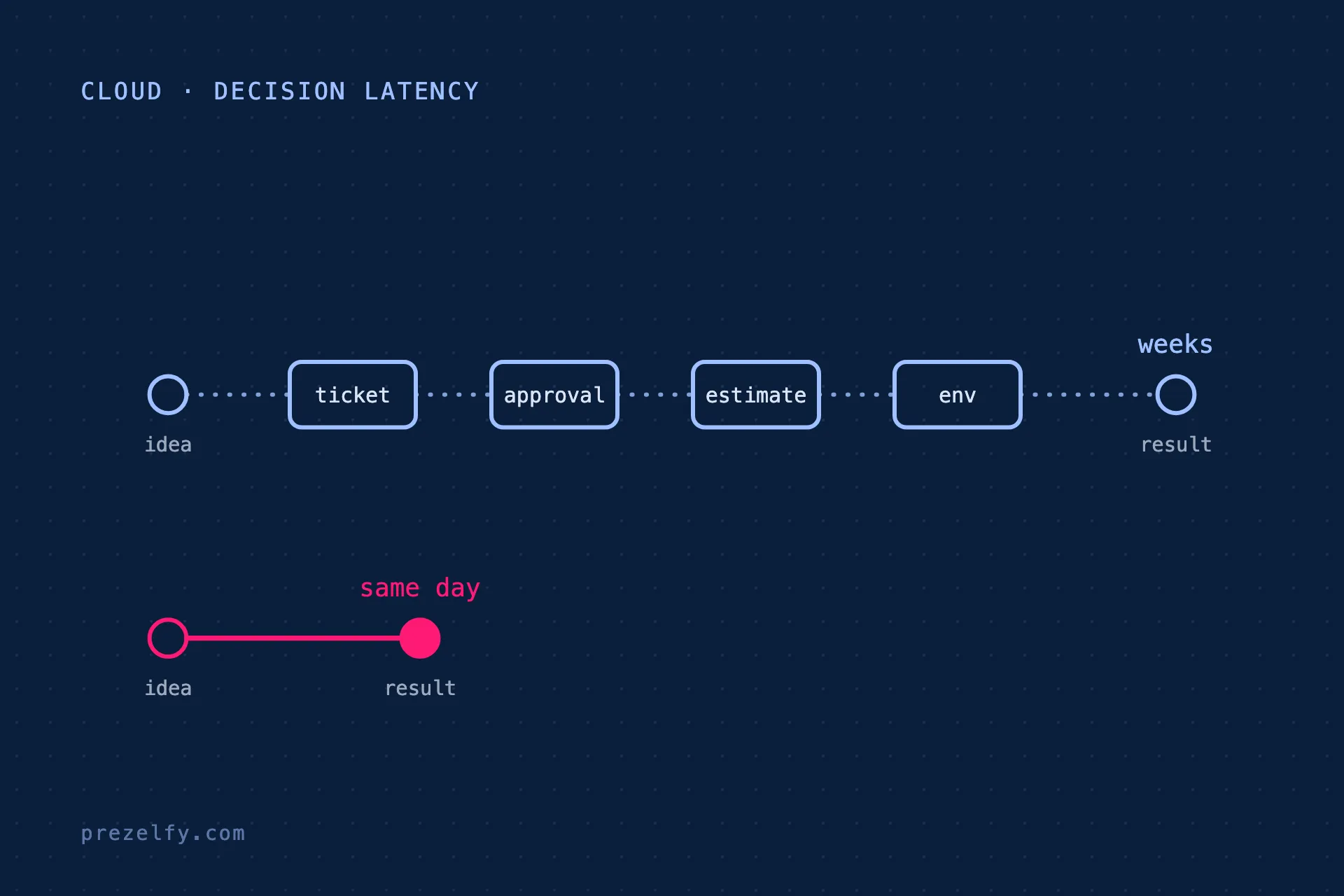
Ask a team what slows them down and you will rarely hear that compute is too expensive or the database is too slow. You will hear about waiting: for an account, for a review, for a test environment, for the one person who knows how the network is set up. Each wait looks small and reasonable on its own. Added together, they decide how many ideas an organization can test in a year, and for most businesses that matters more than any line on the AWS bill.
This waiting has a useful name: decision latency. This article explains what it is, walks through an example of how it builds up, shows how to measure it with nothing more than a spreadsheet, and describes the AWS patterns that reduce it without weakening control. It also covers the cases where a manual approval is still the right choice.
In short: Decision latency is the time between asking a question (“would this work?”) and getting an answer your team can act on. In cloud environments it is caused mostly by process, not technology: tickets, manual approvals, shared environments and knowledge held by a few people. You can measure it from timestamps you already have, and reduce it by replacing repetitive approvals with automated guardrails and self-service.
What decision latency is
Every product and engineering decision runs through the same loop. Someone has a question, such as “would customers use this?” or “would this architecture handle our load?”. The team builds the smallest thing that can answer it, measures the result and decides what to do next. Decision latency is the elapsed time of that loop, from the moment the question is asked to the moment the team has an answer it can act on.
The important word is elapsed. Building the experiment might take a day or two of real work. The loop can still take a month if that work is surrounded by queues. In most organizations the waiting is the larger part, and it is also the least visible, because nobody’s job is to own the time between steps.
Decision latency is related to the “lead time for changes” that the DORA research program uses to measure software delivery, but it is broader. Lead time starts when code is committed. Decision latency starts earlier, when the question is asked, and includes everything that has to happen before anyone can write code: getting an environment, getting access and getting permission.
A worked example
Consider a hypothetical product team that wants to find out whether a new search feature helps users find products faster. The experiment is modest: a small service, a copy of the product catalog and a feature flag that shows the new search to a small share of users.
Here is how that request might travel through an organization that moved its workloads to AWS but kept its data center processes:
- The team opens a ticket for a new AWS account. The platform team has a backlog, so the ticket waits several days before anyone picks it up.
- The platform team creates the account by hand and asks the network team for connectivity to the catalog database. The network team needs a change request, which goes to the weekly change board.
- The change board asks for a cost estimate. The team writes one, and it is approved at the next budget meeting.
- Security reviews the IAM roles. The reviewer is on holiday, so the review waits.
- The team finally gets access and builds the experiment in two days.
The engineering work took two days. Answering the question took most of a month. Nobody acted irresponsibly: each step protects against a real risk. But the organization paid a month of delay for two days of learning, and the team will think twice before proposing its next experiment.
The same request looks very different in a well-designed AWS environment. The team requests a sandbox account through a form or a pull request, and it arrives with networking, logging and guardrails already configured. A budget with alerts is attached automatically. The team deploys from an approved template and has an answer within the week. Every risk the original process addressed is still addressed, only by automation instead of by queues.
Key idea: A manual approval checks a request once, at one moment, by one person. A guardrail checks every request, every time, automatically. Moving control from approvals to guardrails usually makes an organization faster and safer at the same time.
Why it never shows up in cost reports
AWS Cost Explorer shows what you spent on resources. It cannot show what you did not try. Decision latency is paid in other currencies, and three of them are worth naming.
Bigger bets. When every experiment is expensive to start, teams stop running small ones. They bundle ideas into larger projects that justify the overhead, so more work is done before anything is validated. The cost of a wrong assumption grows with the size of the bet.
Self-censorship. People quickly learn which requests are painful, and they stop proposing ideas that would need a new environment or an unfamiliar service. This loss is the hardest to see, because those ideas never reach a backlog where anyone could count them.
Workarounds. When the official path is too slow, determined teams find another one: a personal account, a test run against production data, a tool outside the approved platform. The approvals that were meant to reduce risk end up pushing work to places where nobody can see it.
Where decision latency comes from
Moving to AWS does not remove decision latency by itself. Organizations often migrate their workloads and keep the processes they used for physical hardware, where lead times of weeks were normal because servers had to be ordered and installed. Four patterns cause most of the waiting.
Accounts and environments are created by hand
If a new account or environment needs a ticket and manual setup, every experiment starts in a queue, and the length of that queue depends on how busy the platform team happens to be. Manual setup also drifts: two accounts created by different people a few months apart rarely end up configured the same way, which creates more reviews later.
Approvals stand in for guardrails
Many approvals exist because there was once no other way to enforce a rule. A reviewer checks that a new account has logging enabled because nothing else guaranteed it. On AWS most rules of this kind can be enforced automatically, but the manual review often stays in place long after the automation exists.
Shared, long-lived test environments
When one staging environment serves several teams, testing becomes a scheduling problem. Teams wait for their slot, and when two changes collide, debugging takes longer because nobody is sure whose change broke what.
Knowledge sits with a few people
If only a couple of engineers understand how networking or deployment works, every unusual request flows through their calendars. This is rarely deliberate. It happens when a platform grows faster than its documentation and templates.
How to measure it
You do not need a new tool to start. Pick a handful of recent requests that needed new infrastructure or access, and reconstruct their timelines from tickets, chat messages and pull requests. For each step, record who owned it, when it started and finished, and whether that time was spent working or waiting. A simple table is enough:
| Step | Owner | Started | Finished | Working or waiting |
|---|---|---|---|---|
| Account requested | Product team | Mon 09:00 | Mon 09:20 | Working |
| Ticket in backlog | Platform team | Mon 09:20 | Thu 14:00 | Waiting |
| Account created | Platform team | Thu 14:00 | Thu 16:30 | Working |
| Change board queue | Network team | Thu 16:30 | Wed 10:00 | Waiting |
| Network change | Network team | Wed 10:00 | Wed 11:00 | Working |
An illustrative timeline. Your own will have different steps.
From timelines like this, four measures are useful.
Time to first environment is the time from “we want to try something” to an isolated environment where the team can deploy. It is the best single indicator of how cheap experiments are in your organization.
Infrastructure change lead time is the time from a pull request for an infrastructure change to that change running in production. It shows how quickly the platform itself can evolve.
Waiting share is the time requests spend waiting for a person, divided by the total elapsed time. This is the number that tends to change minds, because it separates the speed of the work from the speed of the process around it.
Time to tear down is how long it takes to remove an experiment cleanly. It is often ignored, but if cleanup is hard, people either stop starting experiments or leave old ones running.
Two cautions. Measure the process, not individuals: the aim is to find queues, not to blame the people working in them. And measure again after every change, because removing one queue often reveals the next one.
Replacing approvals with guardrails on AWS
The goal is not to remove control. It is to move control from people reviewing requests to rules that apply automatically to every request. AWS offers a building block for each of the sources described above.
Account vending
AWS Control Tower sets up a multi-account environment with baseline logging and security controls, and its Account Factory creates new accounts from a standard blueprint. Teams that manage infrastructure with Terraform can use Account Factory for Terraform (AFT), so that a new account is a pull request: reviewed like code, created automatically and configured identically every time. The platform team’s role shifts from creating accounts to maintaining the blueprint.
Preventive guardrails
Service control policies (SCPs) in AWS Organizations set the outer limits of what any account can do, regardless of the IAM permissions inside it. A common example restricts which AWS regions may be used, for data residency or simply to keep the environment manageable:
{
  "Version": "2012-10-17",
  "Statement": [
    {
      "Sid": "DenyOutsideApprovedRegions",
      "Effect": "Deny",
      "NotAction": [
        "iam:*",
        "organizations:*",
        "sts:*",
        "support:*",
        "budgets:*",
        "cloudfront:*",
        "route53:*"
      ],
      "Resource": "*",
      "Condition": {
        "StringNotEquals": {
          "aws:RequestedRegion": ["eu-central-1", "eu-west-1"]
        }
      }
    }
  ]
}
This is a simplified version of the example in the AWS documentation. The NotAction list exempts global services such as IAM that are not tied to a region, and the documentation lists the complete set you should exempt. Once a policy like this is attached to an organizational unit, nobody has to review new accounts for region usage, because using another region is simply not possible.
Detective guardrails
Some rules are better checked continuously than blocked in advance, for example whether storage is encrypted or whether a security group allows traffic from anywhere. AWS Config rules evaluate resources as they change, and AWS Security Hub collects findings across accounts. Routing findings automatically to the team that owns the account closes the loop without a central reviewer in the middle.
Golden paths
A golden path is the easiest way to do a common task correctly: a reusable module for a web service, a data pipeline or a scheduled job that already includes logging, alarms and sensible permissions. On AWS these are typically AWS CDK constructs, Terraform modules or AWS Service Catalog products. Golden paths reduce decision latency twice: teams start faster, and reviewers have less to check because the defaults are already approved.
Ephemeral environments
Instead of one shared staging environment, the pipeline creates a short-lived environment for each branch or experiment and destroys it when the work is merged or abandoned. This needs infrastructure as code and some investment in test data, but it removes the scheduling queue entirely and makes teardown automatic.
Budgets instead of pre-approval
Cost estimates are often requested because there is no other way to limit what an experiment spends. AWS Budgets can alert account owners as spending approaches a threshold and can run budget actions, such as applying a restrictive policy when a limit is reached. Combined with sandbox accounts, this lets teams experiment within an agreed amount without asking first.
When an approval is still the right tool
Not every approval should become automation. Some decisions are rare, high-impact and hard to reverse, and a conversation between people adds real value. Granting access to production customer data, committing to long-term spending such as Savings Plans, opening a new region for regulatory reasons or connecting a third party to your network all fall into this category.
A useful test is to ask whether an approval checks something different each time or the same thing every time. If it is the same check every time, it can usually become a guardrail. If the decision genuinely depends on context, keep the approval, but give it a clear owner and an agreed response time, so that it does not quietly become the slowest step in every request.
Try this: Pick one common request, such as a new sandbox account or a new environment for an existing service. Reconstruct its last three occurrences, mark every step as working or waiting, and list each approval along the way. Next to each approval, write down the risk it addresses and whether a guardrail could address it automatically. You will end up with a short, concrete list of improvements.
Key takeaways
- Decision latency is the time between a question and an answer your team can act on, and most of it is usually waiting, not work.
- It never appears on the cloud bill, but it shows up as bigger bets, fewer ideas and workarounds.
- You can measure it from timestamps you already have: time to first environment, change lead time, waiting share and time to tear down.
- On AWS, account vending, SCPs, Config rules, golden paths, ephemeral environments and budgets replace most repetitive approvals. Keep approvals for rare, high-impact decisions.
Want to find out where decision latency hides in your AWS setup? We review account structure, guardrails and delivery paths, and show which approvals can safely become automation.
Talk to us