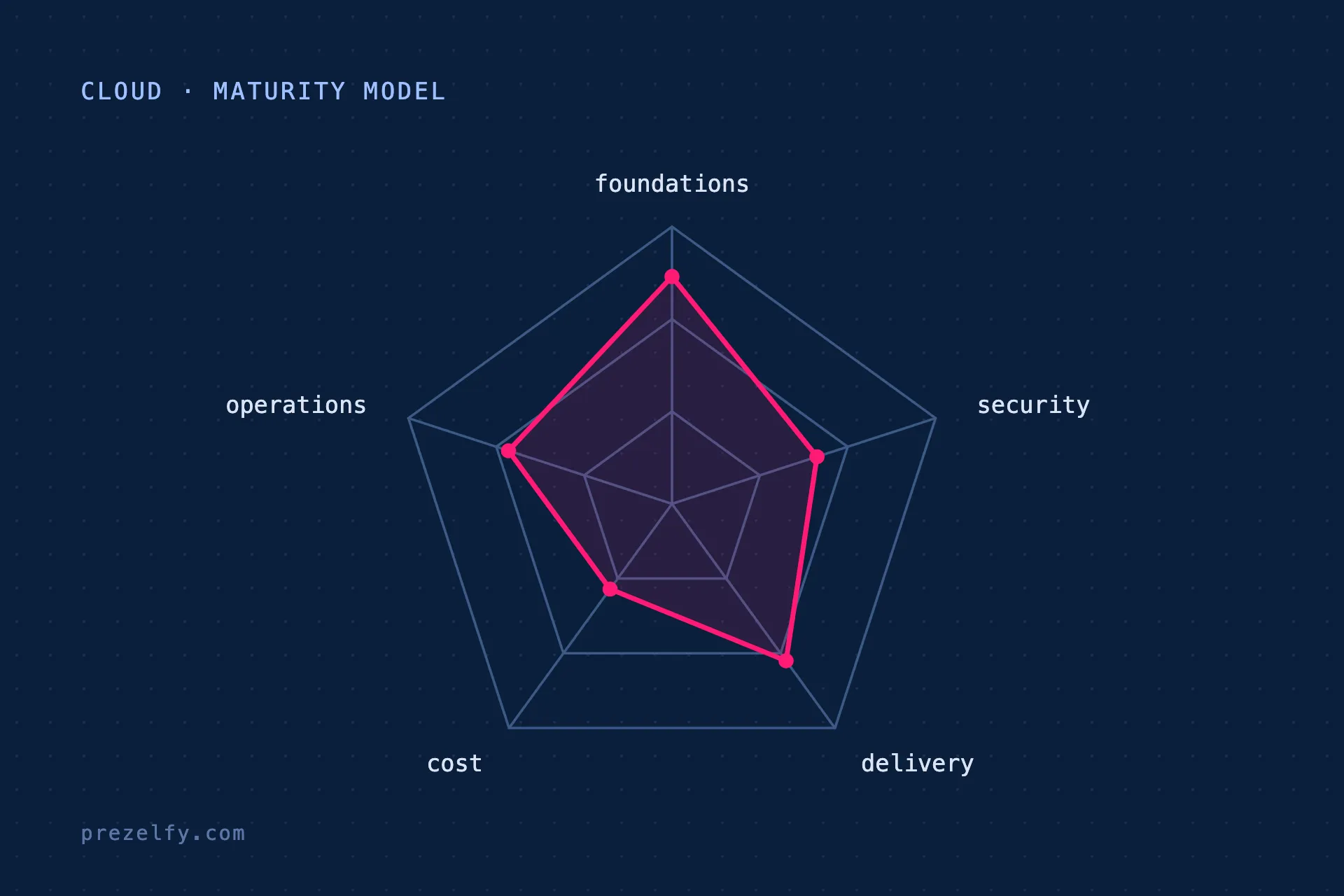
Many organizations moved to the cloud with a cost case: fewer data centers, no hardware refresh cycles, pay for what you use. That case is still valid, but it says little about whether the cloud actually helps the business move. Two companies with similar AWS bills can differ widely in how quickly they launch products, how confidently they pass audits and how calmly they handle incidents. The difference is not how much they spend. It is how mature their cloud capabilities are.
This article describes a practical way to assess that maturity. It covers five dimensions, what early and mature stages look like in each, how to run a self-assessment workshop and how to read the results.
In short: Cloud maturity is the ability to change things safely and quickly, not the number of services you use. Assess it across five dimensions: foundations and ownership, security and guardrails, delivery, cost management, and operations. Improve the weakest dimension first, because it limits all the others.
Why cost is the wrong yardstick
Cost savings measure the cloud as a replacement for a data center. That was a reasonable goal for a migration, but once workloads are running in AWS, the more important question is what the platform lets the organization do. A few questions reveal far more than the monthly bill:
How long does it take a team to go from an idea to something running in production? How confident are we that a change will not break security or compliance? Can we tell what each product costs to run? How quickly do we detect and recover from failures? If these answers are slow or uncertain, a lower bill does not make the cloud a business capability.
Cost still matters, and it is one of the five dimensions below. It is simply not the only one, and on its own it can lead to decisions that save money while slowing everything else down.
The five dimensions
The model draws on the AWS Well-Architected Framework, whose six pillars are operational excellence, security, reliability, performance efficiency, cost optimization and sustainability, and on the AWS Cloud Adoption Framework. It is deliberately simpler: five dimensions that leadership and engineers can discuss in the same room.
1. Foundations and ownership
This dimension covers how accounts, identities and networks are organized, and whether every resource has an owner. It matters because every other dimension depends on it: you cannot route security findings, allocate costs or delegate decisions if nobody knows who owns what. Early-stage organizations typically run a few shared accounts with individual IAM users and unclear ownership. Mature organizations use a multi-account structure in AWS Organizations, provide access through IAM Identity Center and have a named owning team for every account and workload.
Question to ask: Can we name the owner of every production account within a minute?
2. Security and guardrails
This dimension covers how security requirements are enforced and how quickly problems are found and fixed. In early stages, security depends on manual reviews and on the knowledge of a few people, which makes it slow and inconsistent. In mature organizations, preventive and detective controls are defined as code using service control policies, AWS Config and AWS Security Hub, AWS CloudTrail logs are collected centrally, and findings go automatically to the team that can fix them.
Question to ask: If someone exposed a database to the internet today, what would stop it, or who would find out, and how fast?
3. Delivery
This dimension covers how changes get from a developer to production. When infrastructure is changed by hand in the console, environments drift apart, changes are hard to review and releases become events that people schedule around. Mature organizations define all infrastructure as code, deploy it through pipelines, provide reusable modules for common patterns and use short-lived environments for testing.
Question to ask: Could we recreate a production environment from code alone?
4. Cost management
This dimension covers whether spending is visible, owned and acted on. Early on there is one total bill, reviewed monthly by finance, and engineers rarely see it. Mature organizations allocate costs to teams and products through accounts and tags, give each team budgets and AWS Cost Anomaly Detection alerts, and review rightsizing and Savings Plans regularly. The goal is not the lowest possible bill but spending that someone understands and has chosen.
Question to ask: Does each team know what its services cost last month, and has anyone acted on it?
5. Operations and resilience
This dimension covers how well systems are observed and how reliably the organization recovers from failure. Early on, monitoring is basic and incidents are solved by whoever knows the system best, often the same few people every time. Mature organizations define service-level objectives, give teams ownership of their dashboards and alarms, test backups and recovery procedures, and hold blameless reviews after incidents.
Question to ask: When did we last restore a critical system from backup as a test, and did it work?
The table below summarizes the dimensions and three typical stages:
| Dimension | Early | Developing | Mature |
|---|---|---|---|
| Foundations | Shared accounts, unclear owners | Accounts per team, partial ownership | Account per workload, named owners |
| Security | Manual reviews | Some controls as code | Guardrails as code, findings routed |
| Delivery | Console changes | Pipelines for applications | Everything as code, golden paths |
| Cost | One total bill | Costs per account | Costs per team, acted on regularly |
| Operations | Heroes fix incidents | Dashboards and on-call | SLOs, tested recovery, reviews |
Key idea: Your cloud is only as mature as its weakest dimension. A sophisticated delivery pipeline does not help much if nobody knows who owns the account it deploys to, or if nobody notices when it breaks.
How to run a self-assessment
A self-assessment works best as a short workshop rather than a questionnaire, because the discussion is where most of the insight comes from.
Who should attend. One person from leadership, one from the platform or infrastructure team, one from security and two from product teams. Different perspectives are the point: the people who build the platform and the people who use it often see it very differently.
How to run it. Go through the dimensions one at a time. For each, ask everyone to place the organization at early, developing or mature before discussing, then compare and talk about the differences. Write down the evidence for the agreed answer, such as a recent incident, an audit finding or a request that took too long. A worksheet like this is enough:
| Dimension | Stage | Evidence | Where we disagreed |
|---|---|---|---|
| Foundations | |||
| Security | |||
| Delivery | |||
| Cost | |||
| Operations |
How to finish. Pick the weakest dimension and agree on one change for the next quarter that would move it forward, together with how you will know it worked. One concrete change with an owner is more valuable than a long list of recommendations.
Reading the results
The profile across dimensions usually says more than any single score. Three profiles are particularly common.
Strong delivery, weak foundations. Teams ship quickly, but accounts are shared, ownership is unclear and costs are hard to attribute. This often happens in fast-growing organizations. It works until an audit, a security incident or a cost spike forces the question of who is responsible. The next step is usually an ownership map and a multi-account structure for new workloads.
Strong security, weak delivery. Controls are thorough, but they are enforced through manual reviews, and teams wait for them. Security is good on paper, and teams look for ways around it in practice. The next step is to turn the most frequent reviews into guardrails, so that security gets stronger while teams get faster.
Strong foundations, weak cost management. The platform is well organized, but costs are only visible as a total, and nobody acts on them until finance raises an alarm. The next step is cost allocation by account and tag, plus budgets and anomaly alerts per team.
Pitfalls to avoid
Maturity models are useful, but they can also be misused. Three pitfalls are worth avoiding.
Ranking teams. The assessment describes the organization’s platform and processes, not the performance of individual teams. Used as a league table, it stops producing honest answers.
Aiming for mature everywhere. Not every organization needs the highest stage in every dimension. A small company with one product has different needs from a regulated enterprise. The target should follow the business, not the model.
Assessing once. The value comes from repeating the assessment and seeing whether the changes you made had the effect you expected. Once or twice a year is usually enough.
Why this matters for AI
AI workloads depend on the same foundations as everything else: governed data access, identity, logging, cost allocation and reliable delivery. Organizations that are weak in these dimensions find that AI projects stall on the same problems as other projects, only more visibly, because AI raises new questions about data and risk. Improving cloud maturity is often the fastest route to AI in production. The AI-specific foundations are covered in From AI Pilots to AI Services: What to Standardize First.
Try this: Before running a full workshop, answer the five “questions to ask” from this article on your own, and then ask one person from a product team to do the same. Compare your answers. The questions where you disagree most are where to start.
Key takeaways
- Judge the cloud by what it lets the organization do, not only by what it costs.
- Assess maturity across foundations, security, delivery, cost management and operations.
- Improve the weakest dimension first, because it limits all the others.
- Run the assessment as a workshop with mixed perspectives, and repeat it to see whether changes worked.
Want an outside view of your cloud maturity? We run structured assessments across these five dimensions and turn the results into a prioritized, practical roadmap.
Talk to us