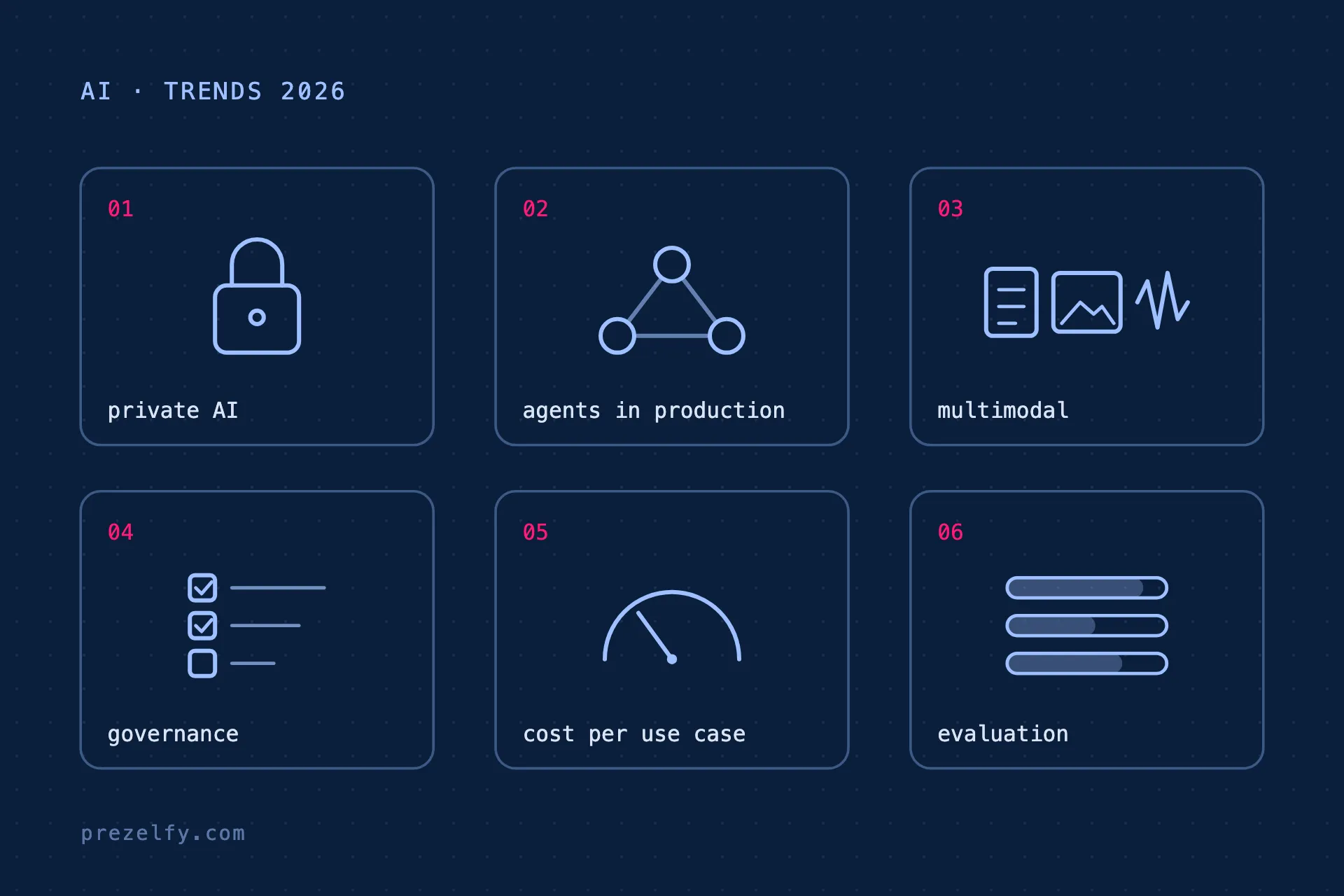
Lists of AI trends are easy to find, and most of them are hard to act on. They tell you that agents are coming or that governance matters, without saying what that means for the systems you run today. This article takes a different approach. It covers six developments that matter for organizations building on AWS, and for each one explains what is changing, why it matters and what a sensible first step looks like.
In short: AI is moving into private environments, into agents that take actions and into document-heavy processes, while governance, cost control and evaluation are becoming everyday engineering work. The trends look different, but they depend on the same foundations: identity, data access, logging, cost attribution and testing.
1. Private and in-region AI
What is changing. Organizations increasingly require AI workloads to run in specific regions, inside their own cloud accounts, with data that stays under their control. Data protection law, sector regulation and customer contracts all push in this direction, and many early experiments with public AI tools ran into exactly these questions.
Why it matters. “Which model is best?” is now joined by “where does the data go, and who can see it?”. Network design, data classification and contracts become part of every AI decision, and a model that cannot be used under your constraints is not an option, however good it is.
First step on AWS. Use Amazon Bedrock in the regions you need and reach it from your VPCs through AWS PrivateLink interface endpoints, so traffic stays on the AWS network. Amazon Bedrock does not use your prompts and responses to train models. If you use cross-region inference to improve availability, check that the inference profile keeps requests within the geography your requirements allow. Then document which models are approved for which classes of data, so teams do not have to ask every time.
2. Agents move into production
What is changing. Assistants that answer questions are being joined by agents that act: they call APIs, update records and run multi-step workflows with limited supervision.
Why it matters. The risk profile changes fundamentally. A wrong answer from an assistant can be ignored; a wrong action from an agent has to be undone. An agent therefore needs its own identity, permissions scoped to what it actually needs, an audit trail of every action and clear limits on what it may do without a person approving.
First step on AWS. Start with agents that only read, and require human approval for any action that changes data. Amazon Bedrock AgentCore provides managed building blocks for running agents, connecting them to tools, managing their credentials and tracing what they do. We describe the architecture in detail in How Enterprises Build Secure and Observable AI Agents on AWS.
3. Multimodal document processing
What is changing. Models that understand text, images, tables and scanned pages together make it practical to automate processes that depend on documents: invoices, contracts, claims, forms and technical documentation.
Why it matters. Much of the business value of generative AI lies less in chat and more in turning unstructured documents into structured data that existing systems can use. These processes are often high-volume, repetitive and well understood, which makes them easier to measure than open-ended assistants.
First step on AWS. Pick one document type with high volume and a clear target structure, such as the fields you need from an incoming invoice. Amazon Bedrock Data Automation and Amazon Textract can extract structured output. Keep a human review step and measure accuracy on a representative sample before removing it.
Key idea: The six trends look different, but they ask for the same foundations: clear identity and permissions, governed data access, central logging, cost attribution and repeatable evaluation. Investing in those pays off for every trend at once.
4. Governance becomes engineering work
What is changing. Regulation such as the EU AI Act, whose obligations apply in stages, together with internal risk policies and customer requirements, expects organizations to know which AI systems they run, what they are used for and how they are controlled.
Why it matters. Governance cannot live only in policy documents. Answering an auditor’s questions requires an up-to-date inventory of AI use cases, logs of what systems did, access controls that can be demonstrated and risk assessments that reflect the current system rather than last year’s pilot.
First step on AWS. Create an inventory of AI use cases with owner, purpose, data used, model and risk level, and keep it next to the code rather than in a forgotten spreadsheet. Enable model invocation logging centrally, and use AWS Organizations policies to control which AI services, models and regions each account may use.
5. Cost per use case
What is changing. As usage grows, AI spending becomes visible in the cloud bill, and the question shifts from “what does AI cost?” to “what does this use case cost, and is it worth it?”.
Why it matters. Model choice becomes an engineering trade-off rather than a default. Smaller, cheaper models are often good enough for classification, extraction and routing, while larger models are kept for tasks that genuinely need them. Without cost per use case, these trade-offs cannot be made.
First step on AWS. Attribute usage per use case, for example with application inference profiles and cost allocation tags. Test cheaper models against your evaluation set before assuming the largest one is necessary. Prompt caching and batch inference in Amazon Bedrock can lower costs for workloads with repeated context or without a need for immediate answers.
6. Evaluation becomes a discipline
What is changing. Models, prompts and data sources change often, and providers release new model versions regularly. Teams that cannot measure quality cannot safely accept those changes.
Why it matters. Without evaluation, a team that has a working AI system is stuck: every change is a risk, so nothing changes, and the system slowly falls behind. With evaluation, changes become routine, just like software changes covered by tests.
First step on AWS. Collect real examples with expected answers for each use case and run them automatically whenever the model, prompt or data changes. Amazon Bedrock Evaluations supports automatic and model-as-a-judge evaluation, and AgentCore Evaluations scores agent behavior from traces.
What to do this quarter
Not every trend needs attention at once. The table below summarizes a first step and a typical owner for each, so you can pick the two or three that matter most for your organization:
| Trend | First step | Typical owner |
|---|---|---|
| Private and in-region AI | Approve models per data class; use private endpoints | Platform and security |
| Agents in production | Start read-only, with human approval for actions | Product team with platform |
| Multimodal documents | Pick one high-volume document type and measure accuracy | Business process owner |
| Governance | Create an AI use-case inventory; enable invocation logging | Risk or compliance with platform |
| Cost per use case | Tag usage per use case; test smaller models | Platform and finance |
| Evaluation | Build a test set for every production use case | Each use-case team |
The foundations behind these steps are covered in more depth in From AI Pilots to AI Services: What to Standardize First.
Try this: Take the table above and mark each trend as relevant now, relevant later or not relevant for your organization. For the ones marked now, check whether the first step already has an owner. Trends that are relevant now but have no owner are where your next AI risk is most likely to come from.
Key takeaways
- Data location and private connectivity are now part of every AI design decision.
- Agents that act need identity, scoped tools, approval steps and tracing.
- Document processing is one of the most practical and measurable areas for multimodal AI.
- Governance, cost per use case and evaluation are engineering tasks, not only policy topics.
Want to know what these trends mean for your AWS environment? We help teams assess their AI readiness and prioritize the foundations that matter most.
Talk to us